Trump Is Holding Congress Hostage Over The SAVE Act

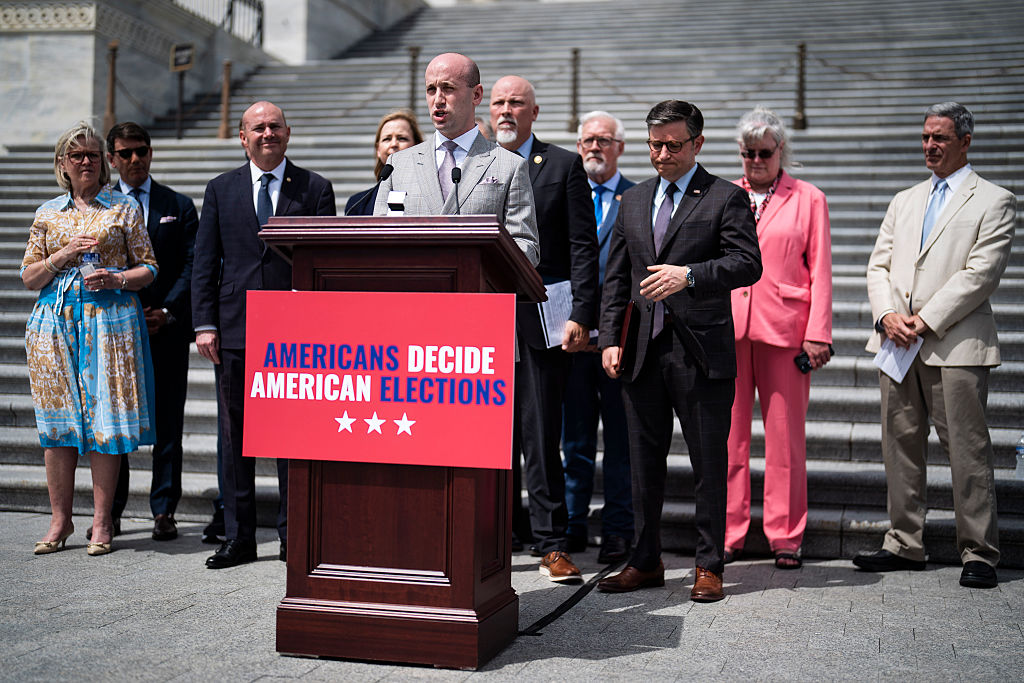
Donald Trump has now escalated his demand that Congress pass the SAVE Act by threatening to refuse to sign other legislation until it is enacted. The bill would require voters to present documentary proof of U.S. citizenship, such as a passport or birth certificate, in order to register to vote in federal elections.
And as if the bill’s sweeping new voting restrictions weren’t controversial enough, he is now insisting that Congress attach unrelated anti-trans provisions to the legislation as well. These bans would prohibit transgender women from participating in women’s sports and place restrictions on gender-affirming medical care for minors.


In other words, the president isn’t just pushing a voter-registration overhaul. He’s effectively holding the rest of the legislative agenda hostage until Congress delivers a package that combines strict new voting rules with hateful culture-war policies.
And the timing is not accidental.
This escalation is unfolding just months before the national midterm elections, where turnout among key voter groups could determine control of Congress. And when you look closely at what the SAVE Act actually does, and who it is most likely to affect, you start to understand why the timing of this push matters.
New documentation requirements would place fresh bureaucratic hurdles in front of Black voters who have historically faced the greatest barriers to the ballot box and have fought the longest battles to vote. Trump and the Republicans know full well that Black voters have long been among the most reliable and influential participants in American elections. In many states and districts, their turnout levels can significantly shape political outcomes.
Republicans claim the SAVE Act is a common-sense election security measure focused on “citizenship verification” and “election integrity.” They argue that the requirement simply ensures that only U.S. citizens participate in federal elections and say that voters should be able to prove citizenship, just as they prove identity for many other government processes. Proponents also contend that tightening documentation rules would strengthen public confidence in the electoral system and prevent even the possibility of non-citizens casting ballots.
But critics say the real impact would be to create new bureaucratic hurdles for millions of eligible voters who do not have those documents readily available. They also point out that numerous studies and election investigations have repeatedly found that voter fraud, particularly non-citizen voting, is exceedingly rare in U.S. elections. Research cited by voting-rights experts also suggests that more than 21 million Americans lack proof of citizenship easily accessible for registration.
If Congress caves to Trump’s pressure, a federal requirement could block or delay registration for large numbers of otherwise eligible voters. And because access to documentation like passports and certified birth certificates is not evenly distributed across the population, those hurdles are unlikely to fall evenly either.
Many people assume that proving citizenship is easy. But obtaining certified documents requires money, paperwork, and time.
Birth certificates can also present problems, especially for older Americans born in the segregated South. During the Jim Crow era, many Black children were born at home and attended by midwives because hospitals routinely denied Black families access. In many cases, those births were never formally recorded by local officials, or the records were incomplete or inconsistent. Historians and voting-rights advocates say the legacy of that uneven record-keeping still surfaces today when elderly Americans attempt to obtain modern identification documents.
The population most likely to encounter these documentation gaps includes Americans born before the civil rights era, when birth registration systems in parts of the South were far less reliable for Black families. According to the U.S. Census Bureau, roughly 56 million Americans are now age 65 or older, and around 10 percent of that group is Black. This means that several million older Black Americans were born during the Jim Crow period, when documentation practices were uneven and discriminatory.
These historical gaps matter because modern voting laws increasingly rely on documentation that many Americans assume everyone already has. Voting-rights experts note that millions of Americans must reconstruct decades-old records in order to obtain birth certificates or other proof of citizenship, a process that can involve navigating state bureaucracies, paying fees, and producing secondary documents.
Similar documentation problems have repeatedly surfaced in battles over voter ID laws and federal identification requirements. civil rights organizations and voting-rights litigators have documented cases in which elderly Black voters in Southern states struggled to obtain identification because they were never issued official birth certificates at the time of their birth. Those stories illustrate how administrative rules that appear neutral on paper can still intersect with the long shadow of segregation and bureaucratic exclusion.
When researchers examine voting laws, they often look not only at what a law says but who is most likely to struggle to comply with it. In the case of documentation requirements, several structural factors matter.
Beyond the elderly population of Black folks whose births were not documented during the Jim Crow era, Black Americans are also less likely to have passports than white Americans. Black households, on average, have significantly less wealth than white households, which can make document replacement fees more burdensome. Communities that have historically faced discrimination often have fewer nearby bureaucratic resources, resulting in longer travel distances or wait times to obtain official records. These disparities don’t mean that Black voters cannot obtain the required documents. But they do mean that the process can be harder, slower, and more costly.
College students could also feel the impact of new documentation requirements.
Many young voters register where they attend school, often hundreds of miles away from the homes where their citizenship documents are stored. College students rarely travel with those records when they move to campus, and retrieving them can require navigating state bureaucracies, paying fees, or coordinating with family members back home. Under a law requiring documentary proof of citizenship, students who do not have passports or certified birth certificates readily available could face new hurdles simply to complete voter registration.
Black households are significantly less likely to have passports and are more likely to face documentation gaps tied to historic record-keeping inequalities. Voting-rights researchers also note that many voter-identification laws refuse to accept student IDs issued by colleges and universities as valid identification. In some states, IDs such as concealed-carry permits are accepted while student IDs are rejected, a discrepancy that civil rights advocates have long argued places additional hurdles in front of younger voters.
That matters because young voters, and especially young voters of color, have become increasingly influential in national elections. Research from Tufts University’s Center for Information and Research on Civic Learning and Engagement (CIRCLE) shows that youth turnout surged in the 2018, 2020, and 2022 election cycles, with young voters leaning heavily toward Democratic candidates.
Students also move more frequently than older voters and often navigate changing addresses, campus housing systems, and state registration rules. Adding new documentation requirements to voter registration could compound those administrative hurdles, creating yet another layer of paperwork between young voters and the ballot box.
This dynamic we’re witnessing under the Trump administration is not new. American voting history is filled with laws that were written in race-neutral language but had racially unequal administrative hurdles and effects. Poll taxes did not mention race, but they disproportionately excluded Black voters who had been systematically denied economic opportunity. Literacy tests did not explicitly name race either, yet they were administered in ways designed to block Black citizens from the ballot box.
Complex registration procedures, grandfather clauses, and “understanding clauses” all operated through similar mechanisms. That history is why voting-rights scholars and civil rights advocates scrutinize new voting requirements so closely. They understand that the question is rarely just what the law says. The deeper question is who will struggle most to navigate it.
Because of that, policies that affect voter access are never simply administrative questions. They quickly become high-stakes political issues. The argument over the SAVE Act is not just another partisan fight in Washington. It is part of a larger and older American conversation about the balance between election security and voter access.
And that brings the story full circle.
Back in January, Trump warned Republicans that losing control of Congress could expose him to investigations and even impeachment. His political survival depends on maintaining a friendly legislature willing to shield him from oversight and legal consequences. That reality hangs over everything happening in Washington now. Which is why his ultimatum over the SAVE Act cannot be separated from the broader struggle for power.
By demanding that Congress rewrite the rules of voter registration before the next national election, Trump is pushing for changes that could shape who finds it easiest, or hardest, to participate in the political system that will ultimately determine his own fate. And the stakes extend beyond a single election cycle.
Trump and his allies have openly flirted with the idea of extending his grip on power beyond the traditional limits of the presidency, including talk, sometimes framed as jokes, sometimes not, about a third term. In that context, battles over voting rules are never just technical disputes about paperwork or identification requirements. They are fights over the future composition of the electorate itself.
Because the power to shape who can participate in democracy has always been one of the most powerful tools in American politics, and one of the most dangerous when wielded by leaders whose political survival depends on narrowing the electorate rather than persuading it.
Dr. Stacey Patton is an award-winning journalist and author of “Spare The Kids: Why Whupping Children Won’t Save Black America” and the forthcoming “Strung Up: The Lynching of Black Children In Jim Crow America.” Read her Substack here.
SEE ALSO:
New Yorker Wunmi Mosaku Illustration Reads Like Visual Version Of N-Word
No, The War With Iran Didn’t Happen Because Kamala Harris Lost
Trump Is Holding Congress Hostage Over The SAVE Act was originally published on newsone.com